Latest Real Estate News

Latest Real Estate News

Subscribe and receive email notifications of new blog posts.


rss logo RSS Feed
DeLand | 1 Posts
Luxury | 2 Posts
Ormond Beach | 1 Posts
Ponce Inlet | 1 Posts
Value | 2 Posts
Waterfront | 2 Posts
May
19

House hunters planning to move this summer may not need as much cash for a down payment —a welcome break for buyers finally catching a bit of good luck. A new report from Realtor.com® economists shows the median down payment fell to $23,400 in the first quarter of 2026—down 19% from a year earlier and marking the lowest level in four years. The shift signals that buyers don't necessarily need the biggest down payment to make the winning bid. "I have clients win houses all the time without having a massive down payment," real estate agent Casey TeVault of Casey Buys Houses in Chino Hills, CA , tells Realtor.com. "Having a big down payment was much more crucial in the past than it is today. When the majority of buyers were putting 20% to 50% down, you lost your competitive edge as a buyer when you came in with 5%. But that's no longer the case." From January through March, the down payment that buyers had to shell out was an average of 12.8% of the purchase price, down 1.2 percentage points year over year. In the first quarter of 2026, the median down payment was more than $4,000 below the fourth quarter of 2025 and more than $5,000 below one year prior. Why are down payments dwindling? Rising inventory and slower price growth are easing pressure on buyers to put more money down upfront. Realtor.com senior economic research analyst Hannah Jones says, "Active listings rose year over year for the 28th consecutive month in April 2026, while home price growth continued to cool, a combination that is giving buyers more negotiating room and reducing the pressure to lead with an outsized down payment." At the peak of the market during the pandemic, Anthony Askowitz , broker at Re/Max Advance Realty II in Miami, tells Realtor.com that "buyers often felt pressured to come in with large down payments, waive contingencies, and present extremely aggressive terms just to compete" Askowitz says at that time, sellers were receiving multiple offers within days, and buyers needed every possible advantage to stand out. "A substantial down payment signaled financial strength, reduced perceived financing risk, and gave sellers greater confidence that the transaction would close smoothly and quickly," he explains. A new report from Realtor.com economists shows the median down payment fell to $23,400 in the first quarter of 2026—down 19% from a year earlier and marking the lowest level in four years. Since the median time on market has now climbed to 52 days, the landscape looks much different. “I recently worked with buyers who successfully secured properties without putting down massive amounts upfront because sellers are becoming more focused on certainty of closing and overall deal structure rather than just the size of the down payment," real estate agent Jessica Julian of Douglas Elliman in Palm Beach, FL , tells Realtor.com. "Strong financing, clean terms, and qualified buyers are carrying more weight again, even in traditionally cash-heavy markets like Palm Beach.” Washington real estate agent Craig Walker says down-payment-assistance loans are also winning deals. "I just closed two, back to back with zero down," the strategic real estate adviser at Real Estate Bees tells Realtor.com. "With the seller providing closing cost assistance in the last deal, the buyer is receiving a refund from an earnest money overpayment." The analyst Jones says government-backed loans are often filling the affordability gap. FHA loans and VA loans —which often require little to no money down—now account for more than a third of all purchase mortgages. According to Jones, FHA's share of purchase mortgages has held above 24% for five consecutive quarters, its most sustained elevated stretch since 2016, while VA loans surged to 11.7% in early 2026, their highest share in over a decade. Sellers making more concessions The Realtor.com 2026 Spring Seller Survey found that nearly 40% of potential sellers now expect to make concessions to close deals , up sharply from 30% in 2025. "This is a signal that even sellers recognize buyers have reclaimed some footing," says Jones. Askowitz says that he is seeing more and more sellers make concessions these days—and the ones who are willing to do so are typically the ones securing deals faster. "We are seeing sellers contribute toward closing costs, offer mortgage rate buydowns, agree to repair credits, extend inspection periods, and in some cases include furnishings or additional incentives to help buyers move forward," he says. "Flexibility has become much more important in today’s market." Cara Ameer , a real estate agent with Coldwell Banker in Florida and California , tells Realtor.com she recently was able to get a buyer $50,000 off the price of a home as a result of inspections. "The buyer could apply the $50,000 reduction any way they wanted," she says. "They opted to reduce the price by $25,000, and the balance was applied towards their closing costs and prepaids with any balance left to reduce the purchase price." Some sellers are even doing repairs themselves to get a deal done. "We're seeing more sellers replacing roofs prior to closing or completing the actual repair work if it's potentially a project with unknowns," Megan Gallagher Weinberg of NEXT MOVE GROUP at Douglas Elliman in Austin, TX , tells Realtor.com. "Buyers are hesitant to take on a project, even if they have a quote for the work today, because there is still uncertainty around future pricing on that work, materials, or what else may come up during the work." Homebuilders are also ramping up incentives to attract cost-conscious buyers , according to real estate agent Stacy Miller of Re/Max Fine Properties in Arizona , forcing resale sellers to keep up. “Resale sellers are having to compete with new construction and are increasingly offering concessions as a result,” she says. #AdamsCameron #Since1963

Read More

May
18

If you’re ready to sell your house for top dollar this summer, curb appeal is likely top of mind. Most real estate agents will agree that giving your landscape a face-lift will pay a homeowner back in spades—and it doesn't even need to cost that much. That’s where annuals come in. Annuals are plants that grow and complete their life cycle in one year or less. Flowering annuals are often enjoyed in planters and gardens due to their beautiful colors and textures, and are a quick, easy way to elevate your home's front yard to entice potential buyers. And no matter which ones you choose, they can allow you to quickly kick your curb appeal up a few notches. The benefits of flowering annuals Most flowering annuals have an extended bloom season as they typically keep flowering from the time you plant them until the end of the season. “This makes them invaluable in garden beds, borders, planters, hanging baskets, and window boxes because they can provide lots and lots of color, texture, and potentially fragrance,” explains Justin Hancock , horticulturist at Costa Farms in Miami . Since you need to replant annuals annually, they offer a great deal of versatility, giving you the chance to mix things up and enjoy a fresh look every year. “It’s fun to try out new varieties or just customize your look and theme,” adds Hancock. Additionally, these plants complete their entire life cycle in a season or year, so they’re ideal for more immediate gratification. An annual will look great the year you plant it, whereas many perennials take two or three years after you plant them to come into their own and really shine. This is a huge plus if you plan to put your home on the market soon. Best flowering annuals for curb appeal If you’re looking to increase your curb appeal with annuals, here are some attractive options to explore: Petunias are one of the many annuals that can help with curb appeal, coming in beautiful colors like purple and red. (Getty Images) 1. Petunias Petunias just might be the queens of annual flowers since they’re easy to grow and very floriferous. In fact, some varieties bloom so much, you can hardly see the foliage. “Available in just about every color you can think of, petunias have pretty good cold and heat tolerance, so in most areas you can plant them in the spring, then enjoy them all the way through summer and into fall,” adds Hancock. Petunias do best in a spot with all-day sun, regular watering, and rich soil. You can enjoy them in garden beds, planters, window boxes, hanging baskets, and virtually any place else you’d like to take in their beauty. Impatiens can be planted in the ground around the yard, but also can be put in planters and boxes for curb appeal. (Getty Images) 2. Impatiens While petunias rule the sun, impatiens rule the shade. Like with petunias, there’s a wide range of colors to choose from, from white to purple to pink to red to orange. They bloom quite a bit and don’t need a great deal of special care or tending to keep them happy. Plant them in late spring, and you’ll be able to enjoy them well into fall. “These annuals thrive when they get all-day shade or morning sun with afternoon shade. They need regular watering or they’ll wilt noticeably as they’ll start to dry out,” says Hancock. Impatiens are ideal in garden beds, planters, window boxes, and hanging baskets. Zinnias are perfect picks for curb appeal, with wide blooms and an array of colors to choose from. (Getty Images) 3. Zinnias According to Hancock, zinnias are old-school annual flowers that are making a comeback. Offered in a wide range of colors, they’re great for attracting bees and butterflies, and also work well as cut flowers if you bring them in for bouquets. They bloom nonstop from late spring to fall and are all about the sun. Although they like regular watering, they’re fairly drought-tolerant. A moist, well-drained soil will keep them in optimal shape. "Zinnias are great for pots and planters, as well as beds and borders. Since they have an upright habit, they’re not as well suited for hanging baskets,” adds Hancock. Snapdragon plants grow tall and colorful during the summer season, making them excellent accent plants for walkways and planters next to stairs. (Getty Images) 4. Snapdragons “I have a soft spot for snapdragons because they offer fantastic vertical interest in the garden with their spikes of fancifully shaped flowers,” says Hancock. Snapdragons, which resemble a dragon’s face, bloom in a range of colors, from white to dark red, and many of them are wonderfully fragrant. They're more of a cool-season annual, so you plant them in spring and enjoy them into the summer (or all summer and fall if you don’t live in a hot area). They thrive in all-day sun or half-shade/half-sun, and they like moist, well-draining soil. While it’s not necessary, frequent fertilization can help them produce more flowers. “Snapdragons are fantastic for beds, borders, and planters. Newer trailing varieties work beautifully in window boxes and hanging baskets,” says Hancock. Heliotropes are beautiful in color and plentiful when planted. But they do need special care to survive the entire season. (Getty Images) 5. Heliotropes “I’m not sure which I love this plant more for, its beauty or its scent,” says Hancock. Heliotropes produce clusters of dark purple flowers that have an intoxicatingly sweet, vanillalike fragrance. These annuals are ideal to plant in the spring. With the sun and regular watering, you can enjoy them throughout the summer and into fall. “Heliotropes are upright-growing plants, so they’re fabulous in beds and borders, as well as pots and planters. Put them right by your front door so anyone who stops by can thoroughly enjoy the fragrance,” explains Hancock. These two-toned pink vinca are perfect for homes in very hot climates. (Getty Images) 6. Vincas Vincas are incredibly heat-resistant summer annuals that make a plethora of flowers all spring, summer, and fall. These blooms come in just about every shade you could ask for except yellow. “Since different varieties have been bred to grow different heights, it's so easy to customize your look. There are even trailing varieties you can use as ground cover or in window boxes,” says Hancock. Vincas require routine watering and love the sun, so plant them in spots where they can easily soak up the rays all day long. Enjoy them in pots and planters or beds and borders. #AdamsCameron #Since1963

Read More

May
18

If your pool is no longer as "cool" as it used to be, you can just go ahead and fill it, right? Not so fast. With the drought that has plagued most of the country this spring, tigheter water restrictions means that some homeowners are thinking for getting rid of their backyard pools all together. While filling in your pool might seem like a quick fix, it can actually leave you with significant damage and hefty repair costs. Homeowners like this one on Reddit user learned the hard way after a contractor filled in their pool incorrectly that filling the pool could cause serious damage to a yard in the process. "I don't like how the pool was used as a trash pit. I don't like that they didn't do layers of fill and compacting each layer," the user wrote in the thread. The moral of the story? If you want to fill in your pool—don’t rush. Make sure it’s done the right way, the first time around, so you can protect your home (and your sanity). Soil shifts, flooding, and failed inspections—how filling in a pool can go wrong At first, filling in a pool might seem like a simple task—but it can quickly turn into a costly disaster. “An improper fill may lead to soil settlement or ground collapse and poor drainage. All of these issues can cause water pooling and intrusion into the home as well as an unstable foundation for patios, additions, or even lawns,” says John Uhe , founding partner and product expert at Discount Salt Pool in Waller, TX . Without proper demolition, fill, and compaction, you can expect hidden sinkholes, uneven stepping stones, sloped fences, and patio cracks. And the worst part? A hastily buried pool will continue to settle for years to come. Also, if you decide to install a shed, room addition, or an outdoor kitchen in the pool area, it might sink, crack, or become unusable over time. In addition, pools are engineered to retain water, and if you don’t break up the shell and reroute drainage, stormwater will collect instead of dispersing. “And don't forget about buried plumbing or electrical lines. This might seem like no big deal until someone drives a stake through them as they’re installing a pergola,” explains Uhe. If you plan to sell your home soon, an improper fill-in can be a red flag for a home inspector—potentially resulting in a failed sale or expensive remediation. “Visible signs will definitely raise questions. Things like uneven landscaping, drainage issues, or subtle yard depressions make inspectors and buyers ask questions. Once they learn a pool was removed, they'll instantly be on high alert,” says Uhe. Filling in your swimming pool is a big job, one that homeowners should avoid, if they can. (Getty Images) You need permits—and the right contractor—to avoid a mess In most places, a pool demolition and fill-in require a permit as a pool is a structural part of your property. Removing it is similar to tearing out a deck or foundation slab. “A permit ensures utilities are safely disconnected, verifies you meet code requirements, and generates documents for resale,” explains Uhe. If you move forward with a pool demolition, you have two options: a partial demolition, which is the most common, or a full demolition. During a partial demolition, the pool’s top shell is broken by 18 to 36 inches. Then, the base is perforated for drainage. With a full demolition, you remove the entire shell, which costs more but eliminates any risk of future issues when building over it. “No matter what type of demolition you choose, you need to cut utilities back to the source. Trace lines back to the panel, breaker, or main line; cap them; and document everything,” says Uhe. As for the fill-in, it isn’t dumped in one go. “It’s added in lifts (like lasagna), and each layer is compacted tight. Fill material, which is usually clean dirt, crushed rock, or a sand-gravel mix, is added in 8- to 12-inch lifts. And only afterward, there will be topsoil and drainage corrections,” explains Uhe. When it’s time to sell, a buried pool may come back to haunt you A filled-in pool can take a toll on your home’s resale value should you decide to sell, especially if you don’t disclose it or complete the project poorly. Some buyers might demand proof of permits or proper documentation—and if you can’t accommodate them, you might be out of luck. There’s also a hidden liability: If the pool cavity was improperly filled and later causes damage or injury, you might be on the hook legally. Depending on your situation, keeping the pool might be a better move that can add anywhere from $15,000 to $25,000-plus to your home value in a warm-weather market. Recent research by Realtor.com® found that, while the number of listings with a pool remains slightly below pre-pandemic levels, the share of pool listings hit an all-time high of 24.4% in April 2025. Most of these listings were in places like Miami ; Phoenix ; Orlando, FL ; and Austin, TX , where pools are highly desirable. Do the math—pool upkeep vs. removal costs So, is it worth it to get rid of your pool? Or, does it make more sense to just let it be? According to Uhe, maintaining a pool might not be drastically more expensive than removing it, especially if the pool is well-built and used regularly. “In a 10-year period, you'll spend roughly $13,000 to $20,000 on maintenance, including small repairs, without major replacements. Proper removal will cost around $10,000 to $15,000. So financially, the numbers are close,” explains Uhe. If resale value is your priority, maintaining the pool might be the smarter move. Going the other route and filling it in may lead to regrets when and if you decide to list your home. #AdamsCameron #Since1963

Read More

May
17

Are Home Prices Going To Fall?

It’s one of the biggest hold ups some buyers have right now: “What if I buy, and home prices go down?”

With everything in the news, that concern makes some sense. No one wants to make a big financial decision at the wrong time. But here’s what’s important to know. You don’t want to get hung up on the few places seeing slight declines right now.

When you zoom out and look at the full picture, home prices usually rise over time.

What the Data Really Shows

Take a look at the visual below. It uses data from Case-Shiller and Bilello to show how home prices have changed year by year going all the way back to the 1950s.

Here’s the key takeaway.

Outside of the housing crash, home prices have either held steady or increased in just about every year for decades (see visual below):
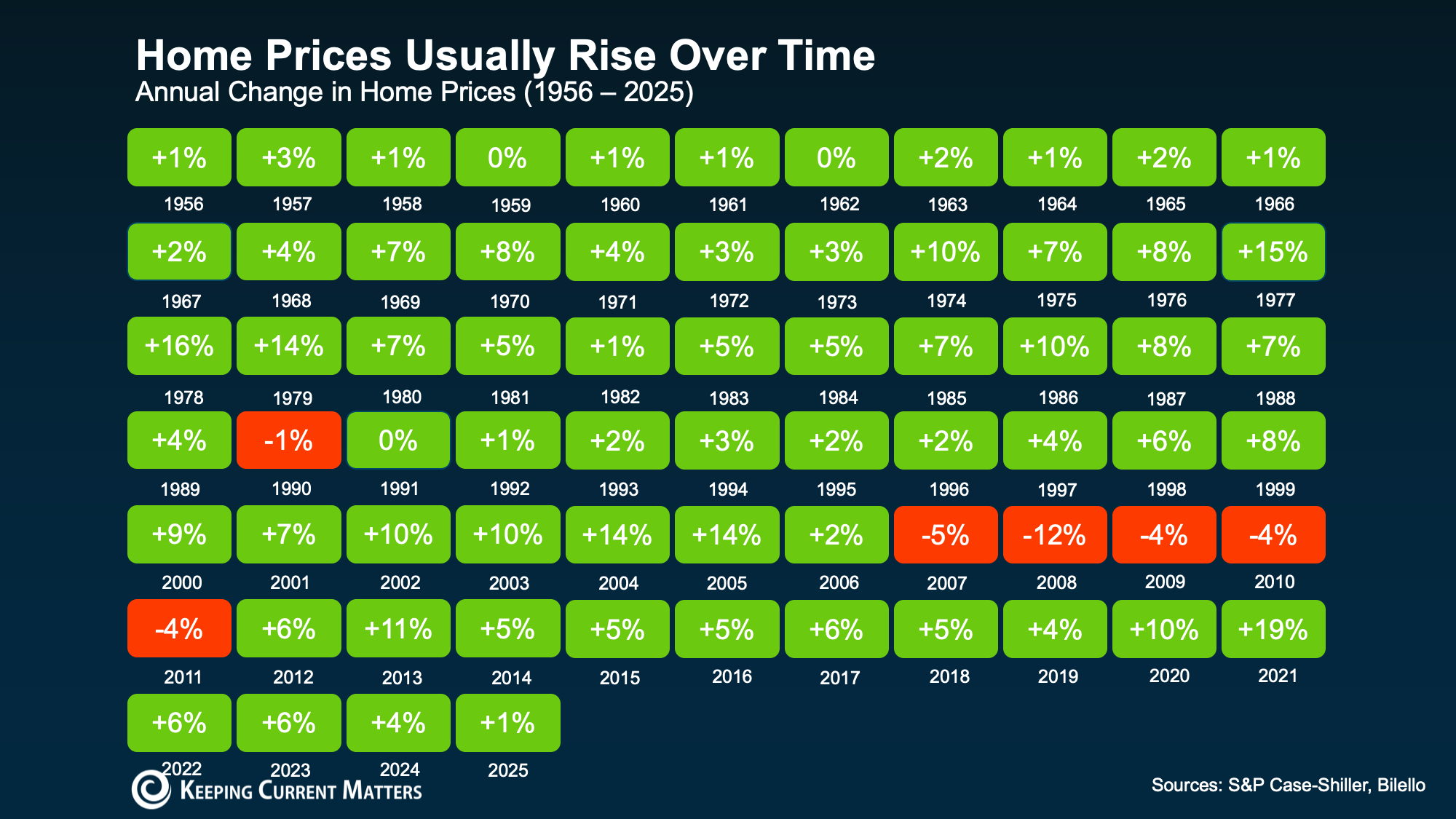
a chart of percentages and numbersThat’s a remarkably consistent track record. And it shows something a lot of headlines miss.

While short-term shifts can happen, it’s the long-term gains that really matter.

Why Prices Tend To Rise Over Time

There are a few core reasons prices usually go up each year:

There are always people who need to move. People need a place to live, and that demand will never fully go away. It may ebb and flow, but someone will always have to move as big changes happen in their life. So, homes stay in demand. There still aren’t enough homes for sale. While the number of homes for sale has grown, nationally there’s still an undersupply based on how many people want a home. That keeps upward pressure on prices. Inflation has an impact. Over time, the cost of goods (including homes) naturally increases. That pushes home values higher. What That Means for You as a Buyer

It’s easy to get caught up in what might happen with home prices next month or next year, especially if you’re a first-time buyer and you’re feeling a little anxious about making such a big financial commitment. But the big picture is clear. Prices usually rise.

That doesn’t mean prices will go up every single year in every market. Real estate is local, and there can be short-term ups and downs. We’re seeing that in some places right now. You can even see it in the few annual dips in the visual above.

But historically, the declines have been temporary.

That’s why it’s generally recommended to buy a home only if you plan to stay for a while – typically at least five years. That’s normally enough time to see your house grow in value. And, it’s enough so you can ride out any short-term changes in the market.

Because when you can do that, something powerful happens. Those rising home values grow your net worth, and by extension, help you build wealth.

The right decision isn’t about timing the market perfectly. It’s about making a move that works for your life and staying in it long enough to benefit from the bigger trend.

Bottom Line

Home prices have a long track record of going up over time. And that’s why buying a home is generally considered a safe long-term investment.

That certainly doesn’t mean you have to buy now. You should only move when it makes sense, and you plan to live there for a while.

But if you’re interested, let this reassure you. If you want to talk about what home prices are doing in our market, your goals, or your timelines, reach out to a local agent.

Members: Sign in now to set up your Personalized Posts & start sharing today!

Not a Member Yet? Click Here to learn more about KCM’s newest feature, Personalized Posts.

#AdamsCameron #Since1963

Read More

May
16

Most homeowners know that mulch supports soil and plant health. What often gets overlooked, however, is its effect on a home’s foundation. Certain mulching habits—such as using moisture-trapping materials too close to the siding or piling mulch too high—can lead to termite infestations and foundation rot. “Mulch traps moisture. That's its job. But thick piles of mulch right next to a house can allow too much moisture to seep down toward the foundation,” explains Lindsey Chastain , founder and CEO at The Waddle and Cluck in Skiatook, OK . By knowing the most common mulching pitfalls and avoiding them as much as possible, you can help protect your home’s structural integrity while reducing the risk of costly (and annoying) repairs. Mulching habits to avoid The most common mulching mishap is what’s known as a "mulch volcano.” “This is where homeowners pile mulch right up against tree trucks or, even worse, the siding and foundation of their home,” says Nathan Stockman , president of Stockman Lawnscape in Pittsburgh . Mulch should never touch a wood structure of any kind. Stockman encourages homeowners to keep mulch at least 6 inches away from siding and no more than 2 to 3 inches deep in beds near the house. Any thicker than that and the mulch is going to hold on to moisture that will latch on to materials that aren't supposed to stay wet. “Termites thrive on damp wood as it’s easier for them to consume. If your siding and foundation is consistently damp because it’s touching thick mulch, you're essentially inviting these insects into your home,” Stockman explains. Allowing old mulch to accumulate year after year is another bad habit. The mulch will stop breaking down, stay damp, and create the perfect habitat for termites. A good rule is to refresh your mulch annually. Adding new layers on top of old, decomposing material won’t cut it. Don’t fret if you do make a mulching mistake. There’s a good chance it’s reversible. If mulch is piled against your siding, pull it back with a rake until you have at least 6 inches of clear space against the house and the depth is down to 2 or 3 inches. Same goes for mulch volcanoes around trees—dig back until you can see the root flare at the base of the trunk. “If you've been adding new layers on top of old mulch for years, scrape the bed down to about an inch of soil contact before refreshing. Otherwise you're just sealing in moisture,” says Stockman. And if you've already noticed termite mud tubes, termites in the siding, or soft spots in trim, call a pest inspector before you do any further mulch work. The pro will need to find the mulch and assess the damage. A mulch volcano has become a staple of landscaping, but it could cause more harm than good. (Getty Images) Organic wood mulches vs. inorganic alternatives Organic mulches like hardwood, cedar, and pine bark break down over time and feed the soil, which is great for plants. The downside is they hold moisture, and that moisture is exactly what termites are looking for when they decide where to nest. “Cedar is the one organic option with natural pest-deterrent properties, which is why we often recommend it for areas close to the home,” says Stockman. Inorganic mulches like crushed stone, river rock, or pea gravel drain instantly and don't decompose. As a result, they are less likely to harbor pests or trap moisture against your foundation. The trade-off, however, is they don't improve soil and they will get hot in summer, which can stress nearby plants. When planning garden beds and landscaping, a combination of organic and inorganic mulch is typically the best solution. Chastain recommends a buffer zone of at least 6 inches between your planting bed and the house. A foot is better if you have the space. “Leave the dirt in the buffer zone free from plants and mulch. Add your inorganic mulch in that area to protect structures and deter pests. Use organic matter in the beds themselves for all their added benefits,” explains Chastain. Best type of mulch to buy The ideal type of mulch depends on where you live. In the Northeast and Midwest, hardwood mulches like oak, maple, or a hardwood blend are the gold standard because they break down at a manageable rate. Plus, most homeowners there work with cool-season grass and standard ornamentals. Cedar is a solid upgrade if termites are a concern as it has natural insect-deterrent oils. In the Southeast and Sun Belt, where termite pressure is much higher, pine straw is one of the better choices. It doesn't pack down or hold moisture the way wood mulch does, and it's widely available. Pine bark also works well. “In arid regions like the Southwest, organic mulches break down too fast in the extreme heat, so most homeowners use crushed stone or decomposed granite, especially close to the foundation,” says Stockman. Pacific Northwest yards usually rely on cedar, fir bark, or shredded wood chips, all of which are plentiful locally. #AdamsCameron #Since1963

Read More

⇦ Newer PostsOlder Posts ⇨

Login to My Homefinder

Pixel