
Latest Real Estate News

Latest Real Estate News

Subscribe and receive email notifications of new blog posts.


rss logo RSS Feed
DeLand | 1 Posts
Luxury | 2 Posts
Ormond Beach | 1 Posts
Ponce Inlet | 1 Posts
Value | 2 Posts
Waterfront | 2 Posts
May
29

Your garage door might seem like a minor part of your home . However, it likely takes up nearly 40% of its front exterior . If your garage door is outdated, worn, or malfunctioning, you may spend anywhere from $500 to $3,000 or even more to replace it. And, if and when you decide to sell, buyers may be turned off and continue their search. “Maintaining your garage door system is similar to getting your car serviced regularly. Many homeowners don't think about it until some type of failure occurs,” explains Alan Bernau Jr , owner and garage/ outdoor storage-shed expert at Alan's Factory Outlet in Luray, VA . By recognizing the importance of a well-maintained garage door and taking the right steps to keep yours in good shape, you can save a great deal of money and headaches. A garage is a coveted feature to any home, whether for storage, workspace, or even conversion into another room. That's why maintaining the door is so critical to potential buyers. (Getty Images) Why neglecting your garage door can cost you Safety, inconvenience, and poor curb appeal are the greatest issues of a vulnerable garage door. “If a door is warped or the track is misaligned, the garage won’t open or close smoothly. It may get stuck in the track or, even worse, come out of it and collapse,” says Justin Evans , vice president of marketing at Clopay , North America’s largest garage door manufacturer based in Mason, OH . Also, a rotted wooden door, rusted-out steel door, or door that doesn't fit tightly and securely in the opening invites water, air, wind, debris, and even critters to come inside the garage, creating a mess and damaging the items inside. “Plus, broken lock mechanisms or deteriorating panels can create an entry point for burglars and increase the risk of theft,” Evans explains. Additionally, a poorly insulated or uninsulated door can affect the temperature inside the garage as well as rooms over and next to it, leading to discomfort, reduced energy efficiency, and higher utility bills. Lastly, if you list your home and your garage door is long past its prime, potential buyers will notice and may walk away, especially if they view the garage as an extension of usable living space. “The garage has become much more important nowadays. I’ve found that many buyers aren’t even considering the garage as something they can park their cars in. Today, the garage represents storage space, exercise rooms, and hobby rooms,” says Charissa Bright , real estate professional and owner at Bright Buys Houses in Watkinsville, GA . How to maintain your garage door Fortunately, it doesn’t take a lot of time or money to keep your garage door in optimal condition. Here’s what you can do: Clean the surface All types of garage doors require surface maintenance to prevent a premature replacement. If you have a wooden garage door, for example, a fresh topcoat or sanding and painting every few years should do the trick. “If you have a steel garage door, clean and wax it with a spray-on car wax at least twice a year or more if you live in a coastal region with salt air or a winter climate with high road salt and chemicals,” says Evans. Wash your door and clean the windows To wash your garage door, use a wet cloth, sponge, or soft bristle brush. Then, rinse thoroughly with clean water. Don’t forget about the windows. Evans recommends cleaning them with a nonabrasive cleaner like dish soap or vinegar and water. Schedule inspections after severe weather If you live in an area that experiences hurricanes or high winds, get your garage door professionally inspected after a large storm to make sure there’s no warping or loose hardware. “High winds can cause a pressure buildup in the garage and blow out the roof of the home, allowing water in and causing serious damage,” explains Evans. Know when to call a pro “Any repairs that involve torsion spring assemblies, frayed cables, significant track realignments, or doors that jerk or shake during normal usage are not DIY-friendly,” explains Bernau. If you notice any of these issues, call a pro to avoid further damage and life-threatening injuries that may occur if you try to replace springs under a lot of tension, for example. #AdamsCameron #Since1963

Read More

May
20

New-construction homes may be hiding a massive, unadvertised money-saver: a built-in discount on home insurance , according to new data. The average annual premium for a newly built home sat a staggering 35% lower than that for a 20-year-old home in 2025—handing buyers $1,002 in annual savings right out of the gate, according to an Insurify analysis conducted for Realtor.com® . When stacked against a 40-year-old property—the median age of America’s housing stock —that premium gap widens to 38%, giving new-construction owners $1,120 in savings. The findings build on recent research from Realtor.com that found new-construction buyers save $25,000 over their first decade of ownership , thanks to lower utility bills and fewer major system repairs. As hopeful buyers stare down another season of elevated mortgage rates and economic headwinds, the potential savings of newly built homes could finally offer some relief and flip the math in their favor. The premium gap between new-construction and older homes Average premiums for a new-construction home sat at an average of $1,828 per year in 2025—well below the national average of $2,948 average annual cost for homes of all ages. (Insurify and Realtor.com) Those savings were driven, in large part, by the newness of these homes. As homes age, maintenance spending heavily concentrates on repairing essential systems, which can trigger insurance claims. But new-construction homes aren’t seen as carrying the same risk, according to Julia Taliesin , economic analyst and licensed insurance agent at Insurify. “Newly built homes are generally less expensive to insure because they have newer roofs, plumbing, and electrical systems and are built to newer safety standards, making them less likely to generate claims,” she explains. To put the scale of these types of repairs and potential claims in perspective, the total estimated cost of needed repairs for homes was $198.4 billion in 2024 alone, according to research from the Federal Reserve Bank of Philadelphia . (Insurify and Realtor.com) But those savings don’t last forever. Taliesin says that insurance costs begin increasing as a home ages, with the biggest jump after the first decade. “The steepest jump occurs within the first 10 years, when average premiums rise from $1,828 for a newly built home to $2,476 for a 10-year-old home,” she says. That translates to roughly a $650 or 35% premium hike by the time the home celebrates its 10th anniversary. The curve continues into the second decade of ownership, though at a more moderate pace. Insurify’s end-of-2025 data shows that the average annual premium for a 20-year-old home climbs to $2,830—about $354 more expensive than for a 10-year-old home, and a whopping $1,002 more expensive than for a brand-new build. “After about 20 years, premium increases become more gradual,” Taliesin says, as the average premium creeps up to $2,889 for 30-year-old homes before finally hitting the national baseline of $2,948 at the 40-year mark. Climate resiliency may add to savings Keep in mind, these national averages don’t take into account regional differences or the volatile shifts driven by an insurance industry sagging under the weight of rising reconstruction costs following natural disasters . While much of this risk was historically viewed as a problem exclusive to coastal regions or fire-prone forests, severe weather exposure has moved inland as hail and extreme wind become systemic issues across the market . Nationally, approximately 18.3% of homes in the U.S. (representing nearly $8 trillion in property value) face severe or extreme risk of hurricane-grade wind damage . Meanwhile, hail threatens more than 1.7 million homes in Chicago alone —representing about $1 trillion in reconstruction cost value. Older homes carry an outsized risk of damage from severe weather, says Taliesin. “Older roofs and aging systems may be more vulnerable to wind, hail, hurricanes, and other severe weather events,” she explains. But new homes are seen as more resilient to these threats, because they have newer components and may be built to newer standards—and that could drive even more savings in these markets. “The difference [between new-construction and older homes] may be more pronounced in regions exposed to severe weather because newer homes and roofs are generally better equipped to withstand storm-related damage,” according to Taliesin. What this means for homebuyers To estimate how much homebuyers might save over their first decade of ownership, Realtor.com modeled home insurance costs for a newly built home and a 20-year old home based on the 2025 data. Based on these findings, a new-construction homeowner could save just over $7,300 in insurance costs during their first decade of ownership compared with buying a 20-year-old home, assuming the premium differentials by home age remain stable over time. These estimates don’t take into account regional differences, potential claims, or changes to premiums driven by insurance carriers—all of which can erase or add to these savings. But caveats aside, the figure offers a glance at what these differences in average premium really mean for homebuyers on the market today. “The real story here is that choosing new construction expands a buyer's budget,” says Joel Berner , senior economist at Realtor.com and author of the Total Construction Report . “What buyers thought they could afford in an existing home when they accounted for operating costs is less than what they can afford in a new home because of the savings we highlight here.” When you combine the insurance advantages with reduced maintenance, a new-construction buyer could pocket as much as $32,000 in savings over 10 years. To put that into perspective, that sum is roughly the cash equivalent needed to permanently buy down a 30-year mortgage rate from 6.5% to 4.00% on a median-priced home with a 20% down payment. And in an environment where affordability seems like a relic of a different era , that extra cash could be a game-changer. In Berner’s words, “Affordability is still a major struggle for buyers across the board, but the savings on operating costs offered by new construction create a little more breathing room.” #AdamsCameron #Since1963

Read More

May
19

Artificial intelligence in the home? It’s a good thing. At least that’s what entrepreneur and home planning expert Martha Stewart is banking on. Last week, she announced the launch of Hint , a new company co-founded by Stewart and home services veteran Yih-Han Ma that reimagines homeownership through the combined power of human expertise and artificial intelligence. Described as an “always-on, AI-native home management platform” via the company’s initial press release, the goal of the app is to “manage and optimize every facet of the home.” Speaking with Realtor.com® shortly after the announcement, CEO and co-founder Ma explains that Hint is coming at a time when homeowners need all the help they can get, especially when it comes to juggling home finances. “We care deeply about making homeownership more affordable for all. We want to help homeowners make smart financial decisions and deliver peace of mind,” he says. How Hint can help At its core, Hint will be an app that will “know your home” and equip homeowners with proactive guidance. “Hint helps homeowners set up and manage critical services like insurance, internet, utilities, and energy plans, while proactively monitoring rates and identifying opportunities to save,” explains Ma, who promises that the app will “deliver concrete, tangible financial value to homeowners at every step.” “For example, understanding a home’s energy usage allows Hint to recommend tailored energy plans that could save homeowners 40% or more. We help homeowners stay on top of critical maintenance, double-check contractor quotes, identify opportunities like property tax appeals or insurance discounts, and understand when DIY makes sense versus hiring a professional—all of which adds up to significant savings.” Along with using public data, homeowners will be encouraged to upload documents like inspection reports and warranties so that Hint can then proactively guide homeowners through maintenance and essential tasks before problems become emergencies. “Homeowners know they need to stay on top of maintenance—it’s just incredibly difficult to do manually, and the mental load is taxing,” says Ma. Take your HVAC, for example. With Hint, the app will track warranties, environmental conditions, and usage patterns to help homeowners stay ahead of any problems. With regular basic maintenance that could be overlooked, especially by a first-time homebuyer, you can add five to 10 years to the life of your HVAC. “The goal is to move homeowners from reactive to proactive homeownership,” explains Ma. But Hint will take its guidance a step further by taking your location into consideration when making recommendations. “From the moment a homeowner gives us their address, the app pulls an incredible amount of public data about that home, everything from weather patterns in the area to soil type to architectural styles,” explains Ma. With that information in hand, the app can offer seasonal shift guidance that could affect your home and your maintenance plans. “In a place like Texas, for example, Hint tracks how the combination of intense summer heat and local clay soils can actually threaten a home's foundation, so it might proactively tell a homeowner to water their foundation to prevent cracking," shares Ma. “Or it would know that a weather system just passed, and since typical storms in Texas can leave wind and hail damage to roofs, recommend that homeowners check before leaks happen. Those are the kinds of expert connections most people wouldn't think to make on their own.” Martha Stewart launches Hint with home services veteran Yih-Han Ma and AI thought leader Kyle Rush. (Getty Images for Nantucket Historical Association) Martha in the mix Since 1993, Martha Stewart has been sharing her wisdom and expertise on running a home, with millions of consumers via books, magazines, TV shows, and appearances. From decor tips to recipes to DIY hacks, Stewart has become an unmatched authority in the home space and as Ma puts it, her expertise is “deeply embedded into every aspect of the platform.” “Martha brings a methodical, deeply researched, and scientific—yet practical—approach to home management,” explains Ma. “I would argue that she's the greatest advocate for the regular homeowner and consumer.” And that is the promise that Stewart and Ma are sharing with prospective users when the app launches in summer 2026. The app will provide proven, researched approaches to everything from choosing siding to the exact time to plant given soil type, with Stewart in the mix to not just provide guidance, but also gear the usability of the tool “Hint is about democratizing access to that level of expertise; she cares deeply about making sure Hint works whether you have a $100,000 house or a $5 million house,” says Ma. “I have always been passionate about showing people how to care for and beautify their homes,” said Stewart in the company announcement release. “Hint brings that philosophy to more people, making the knowledge and expertise behind thoughtful homeownership accessible to everyone. Empowering people to make their home a place they love and one of their smartest investments is core to Hint." #AdamsCameron #Since1963

Read More

May
19

Record High Mortgage Debt Sounds Scary. Here’s What the Headlines Leave Out.

You may have seen the headlines lately about mortgage debt in America hitting a record high. And maybe your brother-in-law brought it up at the dinner table like he’s been waiting all week to spark a debate.

Here’s the thing. He’s not wrong. But he only has half the story. And the half he’s missing? It changes everything.

Spoiler: homeowners are on stronger footing than the headlines suggest, and the housing market has more going for it than most people realize.

The Headline Number Is Real, But It’s Missing Context

Yes, according to the Federal Reserve, there is currently about $14 trillion in mortgage debt in the United States. That is an all-time high. And when you hear that alongside stories about people struggling to pay their bills, it’s easy to assume the worst.

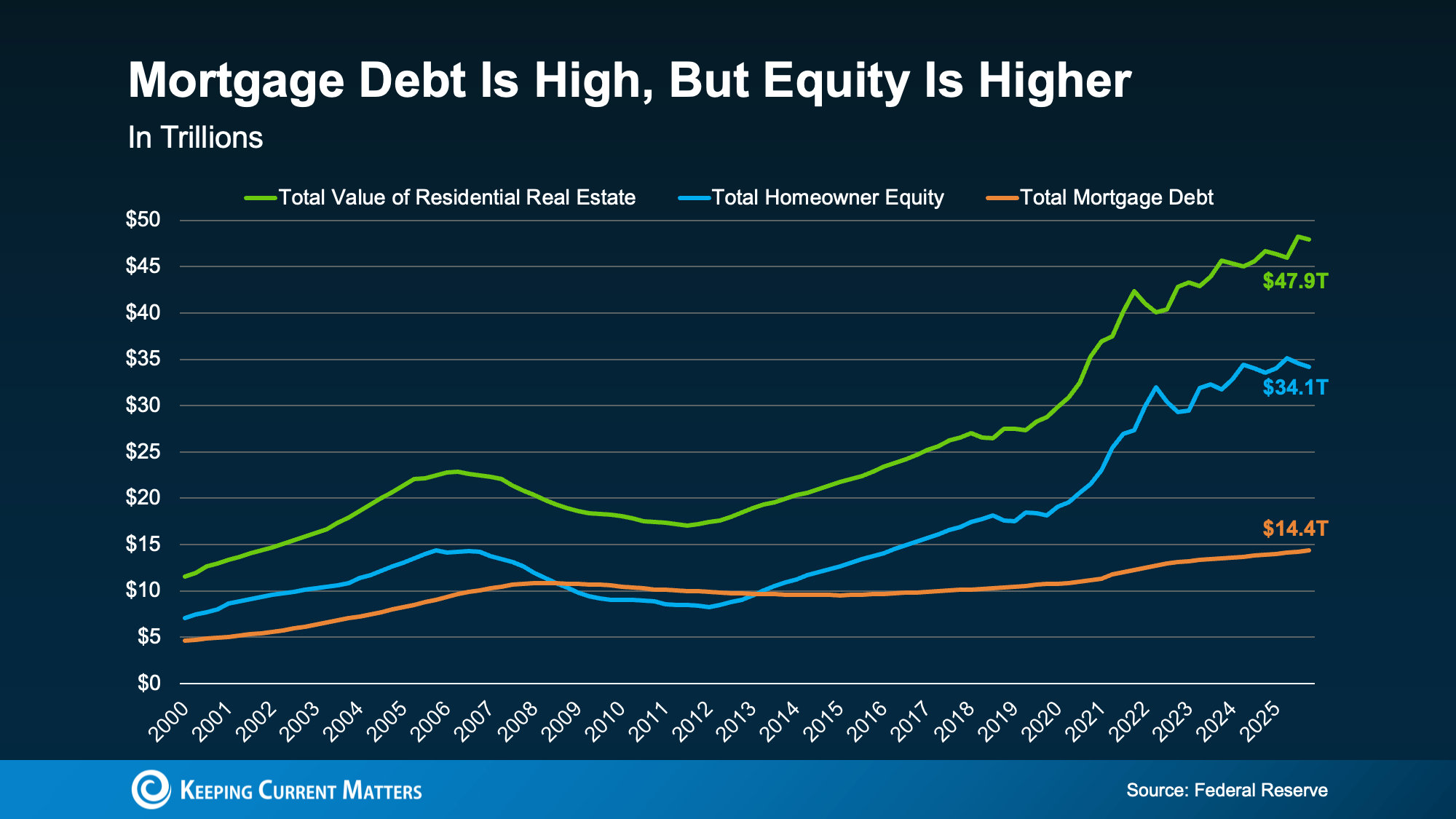
But here’s what the data actually shows (see graph below):
a graph of a graph showing the value of a mortgagea graph of a graph showing the value of a mortgage

This chart from the Federal Reserve tracks three things from 2000 to today: the total value of all U.S. homes (the green line), the equity homeowners hold in those homes (the blue line), and the total mortgage debt owed on them (the orange line).

Right now, home values sit at $47.9 trillion. Homeowner equity is at $34.1 trillion. And the mortgage debt everyone’s worried about? It’s $14.4 trillion.

Debt is at a record high, sure. But the equity homeowners have built up is more than double that number, and it’s also near a record high.

Here’s the part worth pausing on. See the years between 2008 and 2013 where the orange line was higher than the blue one? That’s when the housing market was in genuine trouble. When debt exceeds equity like it did back then, homeowners have no cushion.

So, when prices dropped in 2008, millions of people owed more than their homes were worth and had nowhere to go. That’s what a housing crisis actually looks like. That’s not what’s happening today. Right now, it’s just the opposite.

The gap between what people owe and what they own has never been wider – in a good way. Today, they have far more equity than debt.

Most Homeowners Are in a Rock-Solid Position

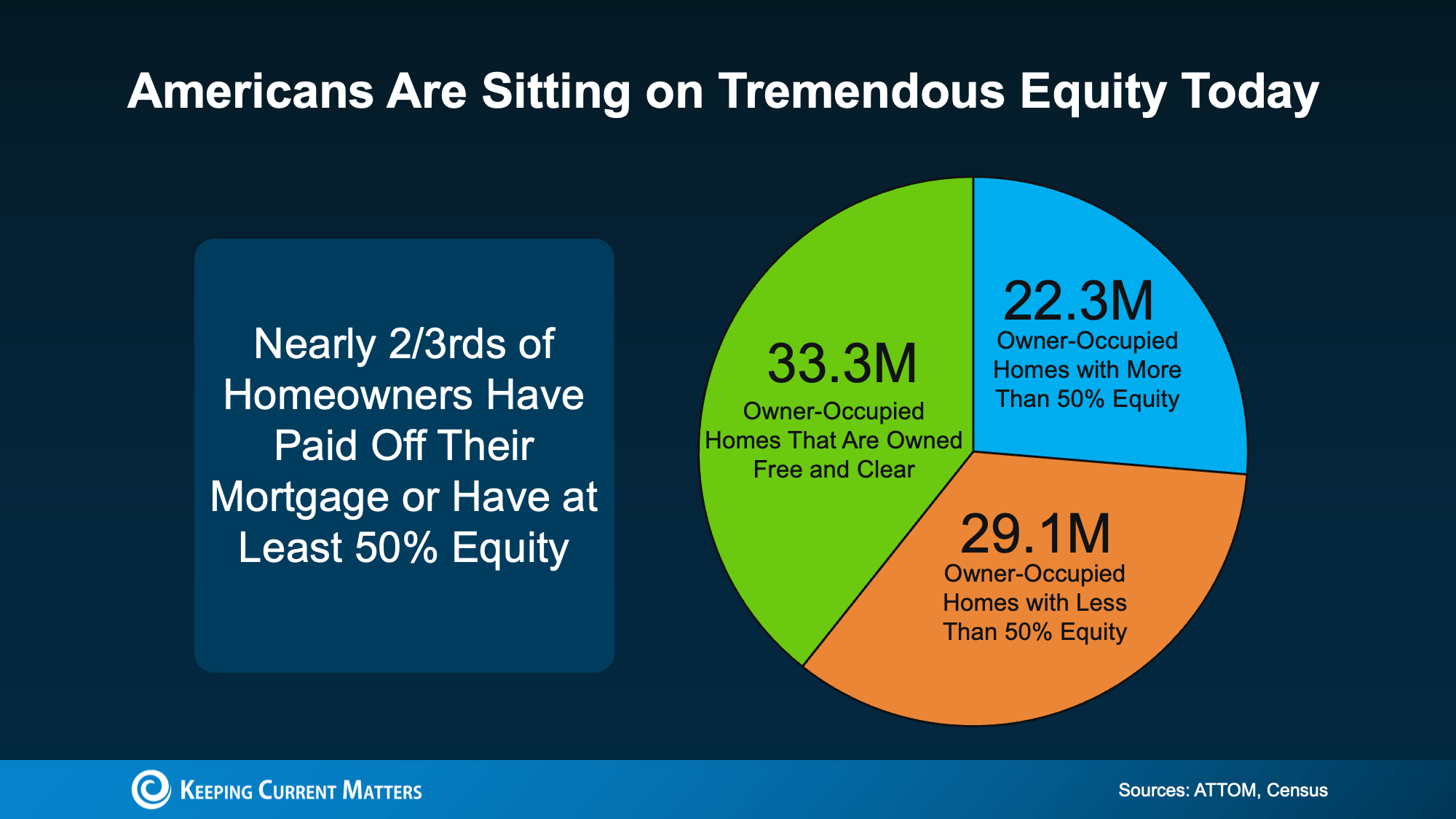
So, we know equity is high nationally. But what does that actually look like at the individual homeowner level? This next chart uses data from ATTOM and the Census to put it in perspective:
a pie chart with texta pie chart with text

Out of all owner-occupied homes in the country, 33.3 million are owned completely free and clear – no mortgage, no lender, no risk of foreclosure. Another 22.3 million homeowners have more than 50% equity in their homes.

Add those together, and you’re looking at nearly two-thirds of all homeowners who have either paid off their mortgage entirely or have such a substantial equity stake that they’re in an extremely stable position.

The remaining slice – 29.1 million homes with less than 50% equity – isn’t a sign of distress, either. That includes plenty of people who recently bought, are building equity over time, and are doing just fine.

The point is this isn’t a market teetering on the edge. It’s a market built on an unusually strong foundation.

Bottom Line

Record mortgage debt makes for a scary headline. But context matters.

Equity is near an all-time high, home values have surged, and the vast majority of homeowners are in a position of real financial strength. The conditions that made 2008 a crisis simply don't exist right now.

If you're wondering what all of this means for your situation, whether you're thinking about buying, selling, or just trying to make sense of the market, a local real estate agent would love to talk it through with you. Reach out anytime. No pressure, just answers.

Members: Sign in now to set up your Personalized Posts & start sharing today!

Not a Member Yet? Click Here to learn more about KCM’s newest feature, Personalized Posts.

#AdamsCameron #Since1963

Read More

May
19

A major weather pattern shift is looming, and if you live in a hurricane-prone area, your window to prepare is closing fast. Headlines touting the arrival of a Super El Niño in 2026 has many homeowners on edge. The good news is this El Niño could actually reduce the number of Atlantic storms this season. The bad news is experts warn it only takes one hurricane to cause catastrophic damage to your home and roof. “No matter what meteorologists call for this season, the homeowners who treat their roof as critical infrastructure (not a maintenance item) will be the ones who don't get caught. The forecast changes every year. The fundamentals don't,” says Brad Strawbridge, founder & CEO at Capital City Roofing in Alpharetta, GA . Regardless of what's to come, now is the time to check your roof and determine whether replacing it before storm season makes sense. Why one storm is all it takes Due to the atmospheric conditions associated with El Niño, meteorologists are predicting a less active Atlantic hurricane season. However, that doesn't necessarily mean homeowners can let their guard down. “El Niño typically increases upper-level winds across parts of the Atlantic Basin, which can disrupt hurricane development through stronger wind shear. That can reduce the overall number of storms. However, fewer storms doesn’t necessarily mean less risk,” says Cheryl Nelson , meteorologist and natural disaster preparedness expert at Prepare with Cher LLC in Norfolk, VA . Nelson points out the exceptionally warm ocean water temperatures associated with El Niño, which act as fuel for tropical systems. “Warmer water can help storms intensify more rapidly and produce heavier rainfall. In addition, climate trends are contributing to stronger storms,” Nelson explains. If you live in an older home with an older roof, you’re likely more vulnerable to severe storm damage from El Niño, especially if you’re in a coastal community that hasn’t been built to modern, hurricane-resistant standards. “A slow-moving storm can be especially destructive because prolonged winds and rainfall place stress on roofing systems for many hours or even days,” adds Nelson. Why a structural roof audit is key before storm season hits The roof is the single most important system in a hurricane. When it fails, everything underneath it fails with it, causing total interior loss, mold remediation, displacement, and months of disruption. “Most homeowners think the question is "will my roof survive?" The real question is "will my roof survive intact enough that water never gets inside?" Those are two very different bars,” explains Strawbridge. During a hurricane, wind doesn't push a roof down, it pulls it up. The primary failure mode is uplift, which means the bond between the shingle and the deck has to hold under massive negative pressure. Three things determine whether it holds: nail pattern and placement, sealant activation, and underlayment quality. “In high-wind zones, a six-nail pattern (versus the standard four-nail) is dramatically more wind-resistant. Most older roofs were installed with four nails per shingle. That's a problem,” Strawbridge says. Also, asphalt shingles rely on a heat-activated sealant strip to bond to the shingle below. If the strip was never bonded properly during installation or has degraded with age, the roof is functionally a stack of loose tiles waiting for the wrong gust. Additionally, felt underlayment is obsolete in hurricane zones. Modern synthetic and self-adhering peel-and-stick underlayments create a secondary water barrier even if shingles get torn off. "This is the difference between a roof repair and a total interior gut," explains Strawbridge. Inspecting your roof is something every homeowner should do once a year. (Getty Images) Is proactively replacing your roof worth it? More times than not, a roof replacement is well worth it, especially if you value peace of mind. While you can spot-repair an aging roof, doing so in a hurricane zone is basically throwing away money. The next storm will find the next weak point. According to Strawbridge, Class 4 impact-rated shingles are the single biggest lever a homeowner has. They're rated to withstand impact from a 2-inch steel ball dropped from 20 feet and can even lead to insurance premium discounts between 5% and 30%, depending on the carrier and state. “In Florida specifically, a wind mitigation inspection on a properly installed Class 4 system can pay for the upgrade through insurance savings alone over the life of the roof,” explains Strawbridge. When it comes to the ROI of a new roof, the math becomes clear once you run the numbers. A preemptive roof replacement in a hurricane zone is typically a five-figure investment. A failed roof in a hurricane is often a six-figure event when you consider the separate hurricane deductible that’s typically 2% to 5% of home value, uncovered losses, contents damage, temporary housing for four to six months, and mold remediation. “Plus the insurance carriers are now non-renewing policies on old roofs in hurricane states. Homeowners with 15-plus year roofs in coastal Florida , Texas , and the Carolinas are increasingly finding themselves uninsurable until they go through a replacement,” Strawbridge says. The moral of the story? Replacing your roof on your own timeline is dramatically cheaper than replacing it on the insurance company's timeline. How to prepare for storm season If your roof is 15 years old or older and you're in a hurricane-prone zip code, prioritize a roof replacement now. “Don't wait for damage. Don't wait for your home insurance company to non-renew you,” Strawbridge advises. It’s also wise to get a roof inspection from a credentialed contractor before storm season—not after. Ask for a wind mitigation report you can submit to your insurance carrier. In the event you do decide to replace your roof, upgrade to Class 4 impact-rated shingles. They cost more upfront but pay for themselves through insurance premium reductions over the roof’s life. Don’t forget to ask your contractor (who you should vet before storm season) whether they install with a 6-nail pattern (versus 4-nail) in high-wind zones. This is non-negotiable for hurricane exposure. “Additionally, demand peel-and-stick or synthetic underlayment—not 15-pound felt. The secondary water barrier is what saves your interior when the shingles fail,” adds Strawbridge. #AdamsCameron #Since1963

Read More

⇦ Newer PostsOlder Posts ⇨

Login to My Homefinder

Pixel